Comparison of NN Descriptors
Comparison of NN Descriptors
[Article: Accuracy evaluation of different machine learning force field features]
This work compares the ability of the descriptor types implemented in MatPL to represent physical systems. The descriptors include cosine descriptors, Gaussian descriptors, moment tensor potential (MTP) descriptors, spectral neighbor analysis potential descriptors, simplified smooth deep potentials with Chebyshev-polynomial descriptors and Gaussian-polynomial descriptors, and atomic cluster expansion descriptors. See the Feature Wiki for details.
For sulfur, NVT AIMD simulations were performed at 300 K and 1500 K. A 2 ps simulation at 300 K produced 2,000 structures. At 1500 K, a 3 ps molecular-dynamics simulation was followed by 2 ps of AIMD to generate the training dataset. Sulfur rings broke during the simulations, providing configurations containing broken bonds.
For carbon, four distinct phases were selected for NVT AIMD simulations from 300 K to 3500 K. High-temperature configurations at 3500 K were added to broaden the configuration space. Each phase was simulated for 1,000 steps, producing a total of 4,000 training structures.
| System | Description | Temperature (K) | Steps (fs) |
|---|---|---|---|
| Sulfur-300 K | α-S 128 atoms | 300 | 2000 |
| Sulfur-1500 K | 128 atoms | 1500 | 2000 |
| Diamond | 64 atoms | 300–3500 | 1000 |
| Graphene | 64 atoms | 300–3500 | 1000 |
| Graphenylene | 64 atoms | 300–3500 | 1000 |
| M-carbon | 64 atoms | 300–3500 | 1000 |
Details and AIMD steps for the sulfur and carbon systems
Selected Results
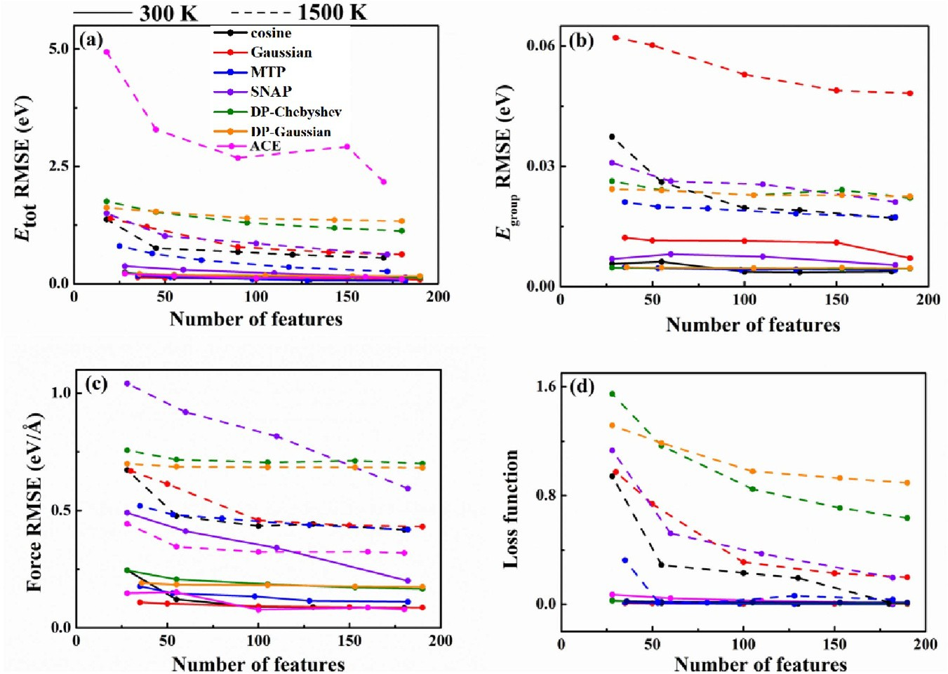
Training errors for different descriptor types on the sulfur-300 K dataset (solid lines) and sulfur-1500 K dataset (dashed lines): (a) total energy, (b) atomic energy, (c) force, and (d) loss function.
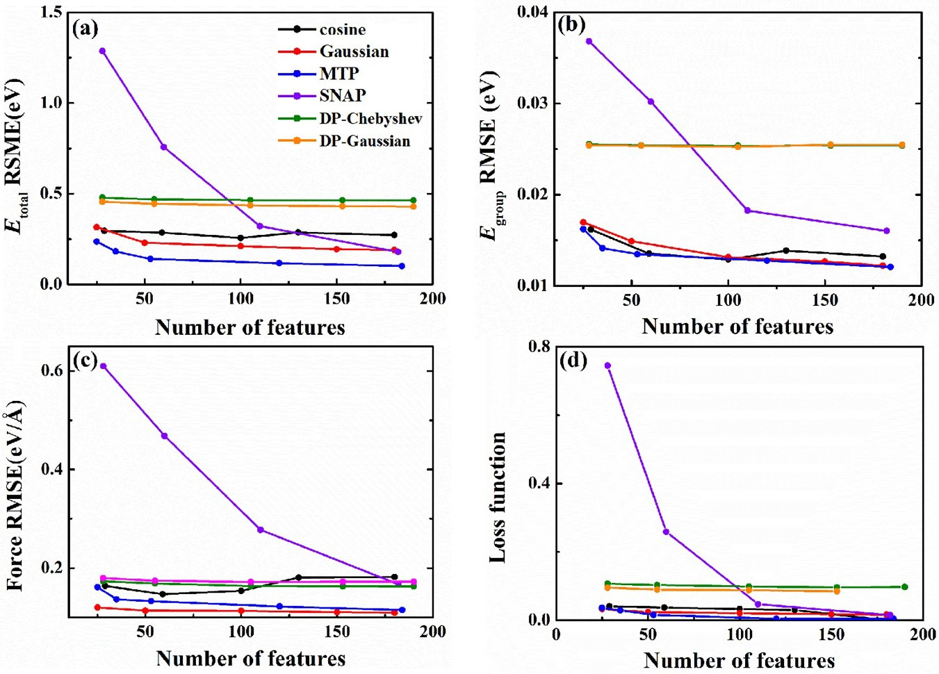
Training errors for different descriptor types on the combined carbon-system dataset: (a) total energy, (b) atomic energy, (c) force, and (d) loss function.