MatPL Literature Examples
This chapter collects selected MatPL benchmarks and published studies that used MatPL as references for users.
Selected Literature
The publications associated with these examples are summarized below. See each corresponding section for details.
This example compares the ability of the feature types implemented in MatPL to represent physical systems. These include cosine features, Gaussian features, Moment Tensor Potential (MTP) features, Spectral Neighbor Analysis Potential features, simplified smooth Deep Potential descriptors with Chebyshev-polynomial and Gaussian-polynomial features, and Atomic Cluster Expansion features. Using a linear regression model, the study evaluates training root-mean-square errors (RMSEs) for atomic-group energies, total energies, and forces against density-functional-theory results for amorphous sulfur and carbon systems. For details about the features, see the Feature Wiki.
For more benchmark details, see the Lonxun WeChat article and the paper [Accuracy evaluation of different machine learning force field features].
2. Simulating Liquid-to-Crystal Silicon Growth with a Machine-Learning Force Field
[Paper: Liquid-to-crystal Si growth simulation using machine learning force field]
This example uses PMLFF to simulate silicon-melt growth far from equilibrium. It shows that an MLFF trained on atomic energies decomposed from first-principles calculations (a PWmat feature) can accurately reproduce the growth process observed in first-principles simulations.
The work proposes a method for correcting systematic bias during ML-FF training, which is important for accurately predicting key quantities such as phase-transition temperatures.
The results demonstrate that an ML-FF can accurately simulate silicon-melt growth and support its use for far-from-equilibrium simulations.

3. Machine-Learning Force Field for Fe–H and the Role of Hydrogen in Crack Propagation in α-Fe
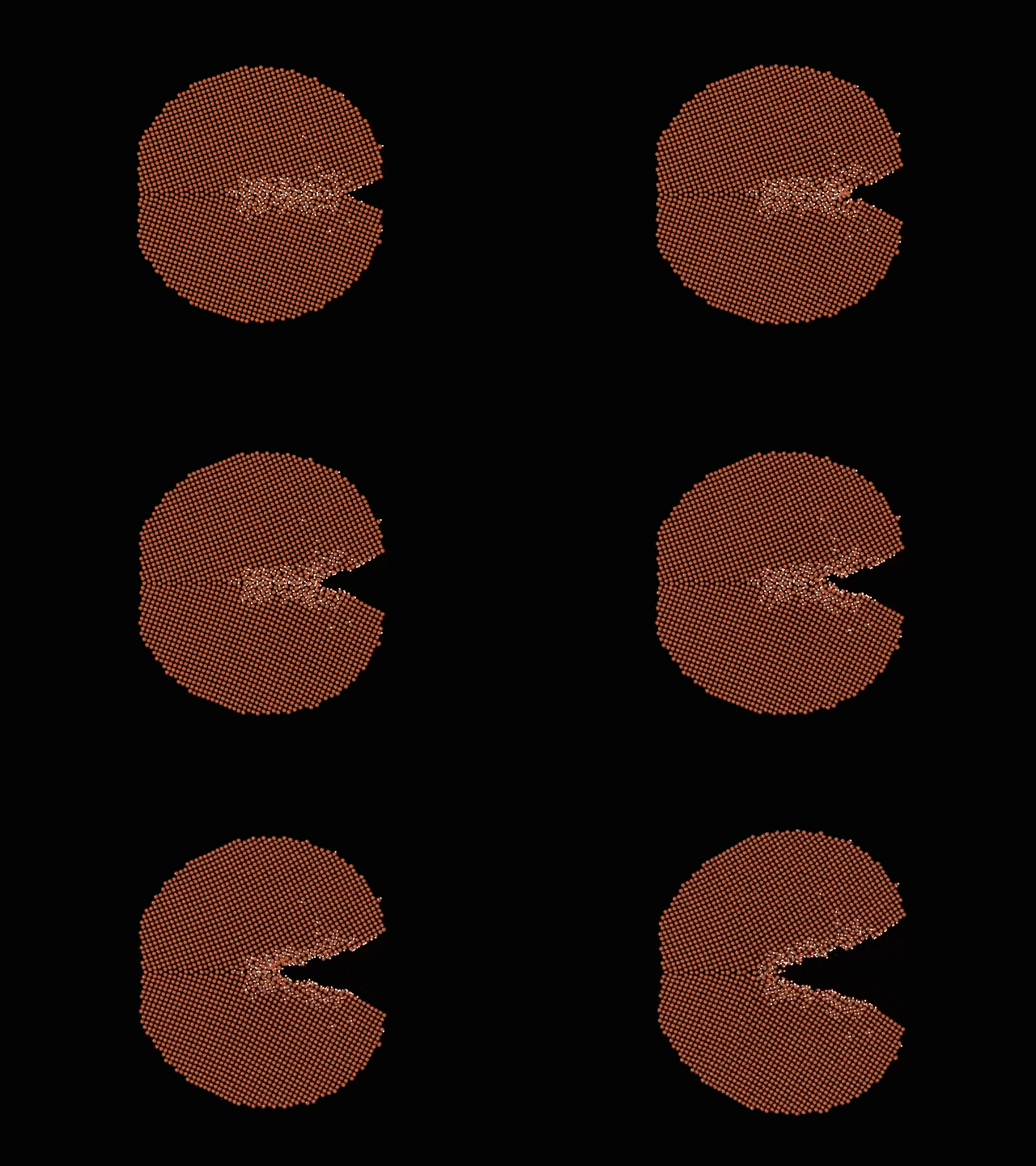
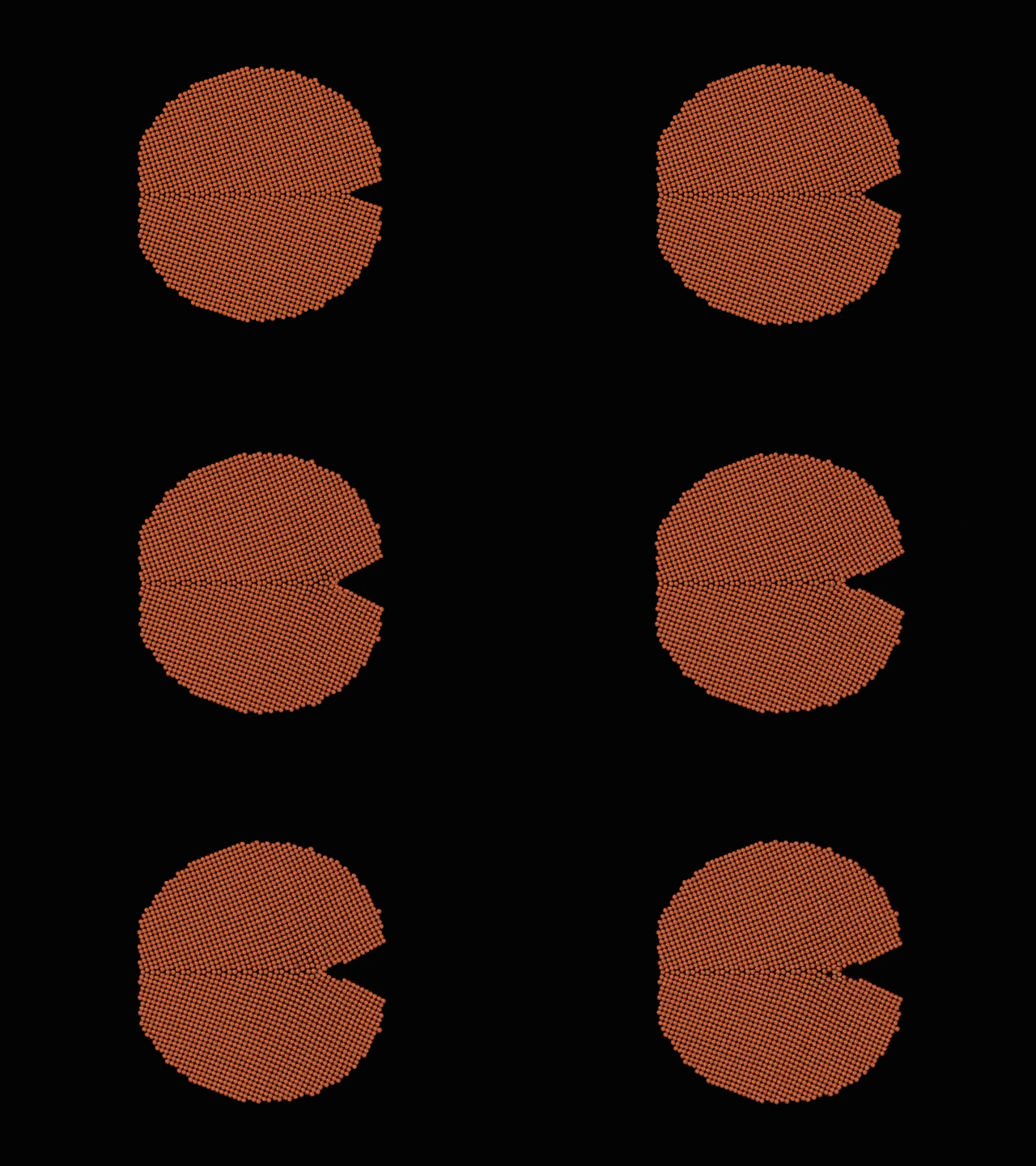
This example studies how hydrogen affects crack propagation in α-iron using a machine-learning force field. Its main findings are: 1. A neural-network force field for the Fe–H system was trained on atomic energies from density-functional-theory calculations and exhibits good statistical and dynamical properties. 2. Molecular-dynamics simulations show that increasing the hydrogen concentration at a crack tip accelerates crack propagation, indicating that hydrogen promotes cracking. 3. In samples containing grain boundaries, microvoids form near the crack tip, relieving tensile stress and facilitating crack growth; their formation, however, appears largely unrelated to hydrogen. 4. Crack propagation is faster in structures with a shorter periodic length along the x direction, possibly because of cooperative effects along x. 5. Compared with embedded-atom-potential results, the machine-learning force field reveals a pronounced influence of hydrogen, highlighting the importance of accurately describing hydrogen–metal interactions. 6. Hydrogen accumulation at the crack tip plays a key role in hydrogen-embrittlement crack propagation, motivating further investigation under different conditions.
4. Morphological Evolution of Lithium Dendrites Revealed by Machine-Learning Force-Field MD
For details, see the [Lonxun WeChat article] and the paper [Revealing Morphology Evolution of Lithium Dendrites by Large-Scale Simulation Based on Machine Learning Force Field].
This example combines a machine-learning force field with a self-consistent continuum-solvation model to simulate the morphological evolution of lithium dendrites in an operating electrolyte. The evolution occurs in two stages. In the first, a decrease in surface-atom energy drives local orientational rearrangement of an initially single-crystal dendrite, producing multiple crystalline domains. In the second, a decrease in internal atomic energy drives those domains to slide along grain boundaries and lowers the grain-boundary energy. The study also examines how different exposed-surface orientations affect dendrite morphology. Overall, reductions in surface and grain-boundary energies drive the morphological evolution.

6. Thermal Conductivity of Amorphous Silicon with a Machine-Learning Force Field