MatPL Parameters
This section describes user-configurable parameters for all models. Basic parameters must be supplied, while advanced parameters have defaults that can be overridden in JSON. A relative path is resolved from the current working directory; an absolute path begins at the filesystem root.
Basic Parameters
model_type
Selects the model type: LINEAR, NN, DP, or NEP.
atom_type
Sets the elements in any chosen order using atomic numbers or symbols. Examples: [29] or ["Cu"] for copper, and [1,6] or ["H","C"] for CH4.
train_data
Specifies training-data paths, either relative or absolute.
- DP and NEP support
extxyz,pwmlff/npy,deepmd/npy,deepmd/raw,pwmat/movement,vasp/outcar, andcp2k/md. - LINEAR and NN support only
pwmat/movement.
valid_data
Specifies validation-data paths, either relative or absolute.
- DP and NEP support
extxyz,pwmlff/npy,deepmd/npy,deepmd/raw,pwmat/movement,vasp/outcar, andcp2k/md. - LINEAR and NN support only
pwmat/movement.
test_data
Specifies test-data paths for the test command, either relative or absolute.
- DP and NEP support
extxyz,pwmlff/npy,deepmd/npy,deepmd/raw,pwmat/movement,vasp/outcar, andcp2k/md. - LINEAR and NN support only
pwmat/movement.
format
Sets the format of train_data, valid_data, and test_data. Supported values include extxyz, pwmlff/npy, deepmd/npy, deepmd/raw, and direct trajectory formats pwmat/movement, vasp/outcar, and cp2k/md. The default is pwmat/movement. See pwdata.
All input datasets must use the same format.
model_load_file
- For fine-tuning or continued training, specifies an initial
.ckptmodel. - For
test, specifies the model path, either relative or absolute.
nep_txt_file
- For fine-tuning or continued training, specifies a
.txtmodel such as GPUMDnep4.txtornep5.txt. - The text file may be a universal force field covering 89 elements. MatPL extracts parameters for the elements in
atom_type, enabling fine-tuning to a smaller model. This can be combined withfix_cij,fix_hiddenlayer, andfix_outlayerundermodel->fitting_net.
recover_train
Whether to resume an interrupted training task. The default is true.
reserve_work_dir
For LINEAR and NN, whether to retain work_dir after execution. The default is false.
save_step
Sets the model-save interval in iterations. The default is None, so models are saved only after each epoch.
max_save_num
With save_step, sets the maximum number of recent models retained. The default is 10.
NEP Model Hyperparameters
The complete NEP model configuration is:
    "model": {
        "descriptor": {
            "cutoff": [6.0,6.0],
            "n_max": [4,4],
            "basis_size": [12,12],
            "l_max": [4,2,1],
            "zbl": 2.0
        },
        "fitting_net": {
            "network_size": 40,
            "fix_cij":false,
            "fix_hiddenlayer":false,
            "fix_outlayer":false
        }
    }
cutoff
Sets radial and angular cutoff radii. The default is [8.0, 4.0].
n_max
Sets n_max for radial and angular descriptors. Each value must be between 0 and 19. The default is [4,4].
basis_size
Sets the radial and angular basis sizes. Each value must be between 0 and 19. The default is [8,8].
l_max
Sets angular expansion orders and enables four- and five-body descriptors. The default [4,2,1] contains the three-, four-, and five-body orders. Use [4,0,0] for three-body only or [4,2,0] for three- and four-body descriptors.
The numbers of two-, three-, four-, and five-body descriptors are n_max[0]+1, (n_max[1]+1)*l_max[0], n_max[1]+1, and n_max[1]+1, respectively.
network_size
Sets the number of neurons in NEP's single hidden layer. The default is 40.
zbl
Sets the outer cutoff of the Ziegler–Biersack–Littmark (ZBL) potential (DOI: 10.1007/978-1-4615-8103-1_3); the inner cutoff is fixed at half the outer cutoff. It is disabled by default. A value in is recommended.
use_typewise_cutoff_zbl
Enables type-wise ZBL cutoffs. The outer cutoff for a pair is min(zbl, use_typewise_cutoff_zbl × sum of covalent radii), and the inner cutoff is fixed at 0.0. Disabled by default; introduced in MatPL-2026.3 Update 1.
fix_cij
Fine-tuning option that freezes NEP two- and three-body feature coefficients. The default is false.
fix_hiddenlayer
Fine-tuning option that freezes NEP hidden-layer parameters W0 and B0. The default is false.
fix_outlayer
Fine-tuning option that freezes NEP output-layer parameters W1 and B1. The default is false.
Interpreting NEP.txt
A standard NEP.txt header is shown below.
nep5   2 O Hf           # Number of element types, followed by their symbols
zbl 1 2                 # Present only when ZBL is enabled during training
cutoff 6.0 6.0 108 108  # Two-body cutoff, many-body cutoff, and their maximum neighbor counts
n_max  4 4              # Two-body and many-body n_max
basis_size 12 12        # Two-body and many-body basis_size
l_max  4 2 1            # Three-, four-, and five-body l_max values
ANN    40 0             # 40 hidden neurons; 0 is a placeholder
The remaining lines contain four blocks: network parameters, two-body coefficients, three-body coefficients, and normalization values.
-
Block 1 contains network parameters for . Its size is
number of elements × (number of features × ANN[0] + ANN[0] + ANN[0]) + number of elements. For each element in header order, it storesW0,B0, andW1, followed by oneb1per element. A GPUMD-trained NEP4 file stores only oneb1, the mean across elements.W0is flattened row-major from[ANN hidden units, number of features]. -
Block 2 contains two-body coefficients:
number of elements² × (n_max[0]+1) × (basis_size[0]+1). -
Block 3 contains three-body coefficients:
number of elements² × (n_max[1]+1) × (basis_size[1]+1).In either coefficient block, the matrix order is
[I,J,N,K]:Iis the central element,Jis the neighbor element, both following header order;N=n_max+1; andK=basis_size+1. -
Block 4 contains one normalization value per feature, ordered by two-, three-, four-, and five-body terms. Their counts are
n_max[0]+1,(n_max[1]+1)*l_max[0],n_max[1]+1, andn_max[1]+1.
DP Model Hyperparameters
The complete DP model configuration is:
    "type_embedding":false,
    "model": {
        "type_embedding":{
            "physical_property":["atomic_number", "atom_mass", "atom_radius", "molar_vol", "melting_point", "boiling_point", "electron_affin", "pauling"]
        },
        "descriptor": {
            "Rmax": 6.0,
            "Rmin": 0.5,
            "M2": 16,
            "network_size": [25,25,25]
        },
        "fitting_net": {
            "network_size": [50,50,50,1]
        }
    }
type_embedding
Configures type embedding for DP training. You may also set "type_embedding":true alongside model, which uses ["atomic_number","atom_radius","atom_mass","electron_affin","pauling"]. The default is false.
physical_property
Selects physical properties for DP type embedding. Eight properties are available:
atomic_number: atomic numberatom_mass: atomic massatom_radius: atomic radiusmolar_vol: molar volumemelting_point: melting pointboiling_point: boiling pointelectron_affin: electron affinitypauling: Pauling electronegativity
The default physical_property is ["atomic_number","atom_radius","atom_mass","electron_affin","pauling"].
Rmax
Maximum cutoff radius of the DP smoothing function. The default is .
Rmin
Minimum cutoff radius of the DP smoothing function. The default is .
M2
Sets the DP embedding-network output dimension and therefore the fitting-network input dimension. In the example, these are 25 × 16 and 25 × 16 = 400. The default is 16.
network_size
Sets the embedding- and fitting-network structures. Defaults are [25,25,25] and [50,50,50,1].
Embedding network: Input -> hidden layer 1 (25 neurons) -> hidden layer 2 (25 neurons) -> output layer (25 neurons)
Fitting network:
Input (M2 × 25) -> three hidden layers (50 neurons each) -> output (1 neuron)
NN Model Hyperparameters
The complete NN model configuration is:
    "model": {
        "descriptor": {
            "Rmax": 6.0,
            "Rmin": 0.5,
            "feature_type": [3,4]
        },
        "fitting_net": {
            "network_size": [15,15,1]
        }
    }
Rmax
Maximum feature cutoff radius. The default is .
Rmin
Minimum feature cutoff radius. The default is .
feature_type
Selects feature types. Supported values are [1,2], [3,4], [5], [6], [7], and [8]. The default [3,4] selects two- and three-body Gaussian features. See Appendix 1.
network_size
Sets the fitting-network structure. The default [15,15,1] gives:
Input -> hidden layer 1 (15 neurons) -> hidden layer 2 (15 neurons) -> output (1 neuron)
Linear Model Hyperparameters
The complete Linear model configuration is:
    "model": {
        "descriptor": {
            "Rmax": 6.0,
            "Rmin": 0.5,
            "feature_type": [3,4]
        }
    }
Rmax
Maximum feature cutoff radius. The default is .
Rmin
Minimum feature cutoff radius. The default is .
feature_type
Selects feature types using the same settings as the NN model. Supported values are [1,2], [3,4], [5], [6], [7], and [8]. The default [3,4] selects two- and three-body Gaussian features. See Appendix 1.
ADAM Optimizer Hyperparameters
The complete ADAM configuration is:
    "optimizer": {
        "optimizer": "ADAM",
        "epochs": 30,
        "reset_epoch":false,
        "batch_size": 1,
        "print_freq": 10,
        "lambda_2" : 0.1,
        "learning_rate": 0.001,
        "stop_lr": 3.51e-08,
        "stop_step": 1000000,
        "decay_step": 5000,
        "max_norm": 0.5,
        "norm_type": 2,
        "t_0": 6,
        "t_mult": 1,
        "train_energy": true,
        "train_force": true,
        "train_virial": false,
        "start_pre_fac_force": 1000,
        "start_pre_fac_etot": 0.02,
        "start_pre_fac_virial": 50.0,
        "end_pre_fac_force": 1.0,
        "end_pre_fac_etot": 1.0,
        "end_pre_fac_virial": 1.0
    }
optimizer
Selects the optimizer. The default is ADAM; use LKF for the LKF optimizer. See the LKF paper.
reset_epoch
Whether restarted training begins at epoch 0. The default is true. Set false to resume from a checkpoint and restore ADAM's first- and second-moment states.
epochs
Sets the number of epochs. Each epoch processes the entire dataset in mini-batches with forward propagation, loss calculation, and backpropagation. The default is 30.
Choose the epoch count by monitoring training and validation. Too few epochs may underfit; too many may overfit and reduce generalization.
batch_size
Sets the number of samples in each mini-batch. The default is 1.
print_freq
Sets the number of mini-batch iterations between training-error reports. The default is 10.
train_energy
Whether to train on total energy. The default is true.
train_force
Whether to train on forces. The default is true.
train_virial
Whether to train on virials. The default is false.
lambda_2
Sets ADAM L2 regularization. It is disabled by default and may reduce overfitting.
learning_rate
Initial ADAM learning rate. The default is 0.001.
stop_lr
Minimum learning rate. Once reached, it remains fixed. The default is 3.51e-08.
stop_step
Step at which learning-rate decay stops and the rate equals stop_lr. The default is 1000000.
decay_step
Learning-rate decay interval. The default is 5000 steps.
learning_rate, stop_lr, stop_step, and decay_step determine the schedule as follows:
decay_rate = np.exp(np.log(stop_lr/learning_rate) / (stop_step/decay_step))
real_lr = learning_rate * np.power(decay_rate, (iter_num//decay_step))
First calculate decay_rate:
Then update the learning rate:
where iter_num is the training iteration.
Energy and Force Prefactors in the Loss
Force, energy, and virial prefactors:
-
start_pre_fac_force: force-loss prefactor at the start of training. Must be nonnegative; default100. -
end_pre_fac_force: force-loss prefactor at the end of training. Default1.0. -
start_pre_fac_etot: total-energy prefactor at the start of training. Default1.0. -
end_pre_fac_etot: total-energy prefactor at the end of training. Default1.0. -
start_pre_fac_virial: virial prefactor at the start of training. Default0.1. -
end_pre_fac_virial: virial prefactor at the end of training. Default0.1.
Loss-prefactor calculation:
During ADAM training, each loss prefactor depends on the current real_lr:
lr_ratio = real_lr / learning_rate
lr_ratio = min(max(lr_ratio, 0.0), 1.0)

prefactor = end_prefactor + (start_prefactor - end_prefactor) * lr_ratio
Equivalently:
where x may be force, etot, or virial.
At the start of training:
Therefore:
Later, as the learning rate decreases:
Therefore:
Loss formula:
Total loss combines enabled force, total-energy, and virial terms:
- Each term uses
MSELoss:
- is force loss.
- is total-energy loss.
- is total-virial loss.
- is the mean atom count per structure in the current batch.
- , , and are the corresponding prefactors.
Because Etot and Virial are structure-level totals, dividing them by N_avg makes their scale closer to per-atom quantities and prevents larger systems from receiving inherently greater weight.
Gradient Clipping
Norm-Based Clipping: max_norm and norm_type
max_norm and norm_type configure norm-based clipping. The default max_norm=None disables it.
If the norm of all parameter gradients exceeds max_norm, gradients are scaled proportionally until the norm equals max_norm.
This preserves relative gradient directions while preventing exploding gradients. norm_type selects the norm.
norm_type is integer 1 for L1 or 2 for L2. The default is 2.
The L1 norm is the sum of absolute gradient values: , If , gradients are scaled to
The L2 norm is the Euclidean gradient norm: , If , gradients are scaled to
Value-Based Clipping: clip_value
Clips each gradient component to [-clip_value, clip_value]. The default None disables it.
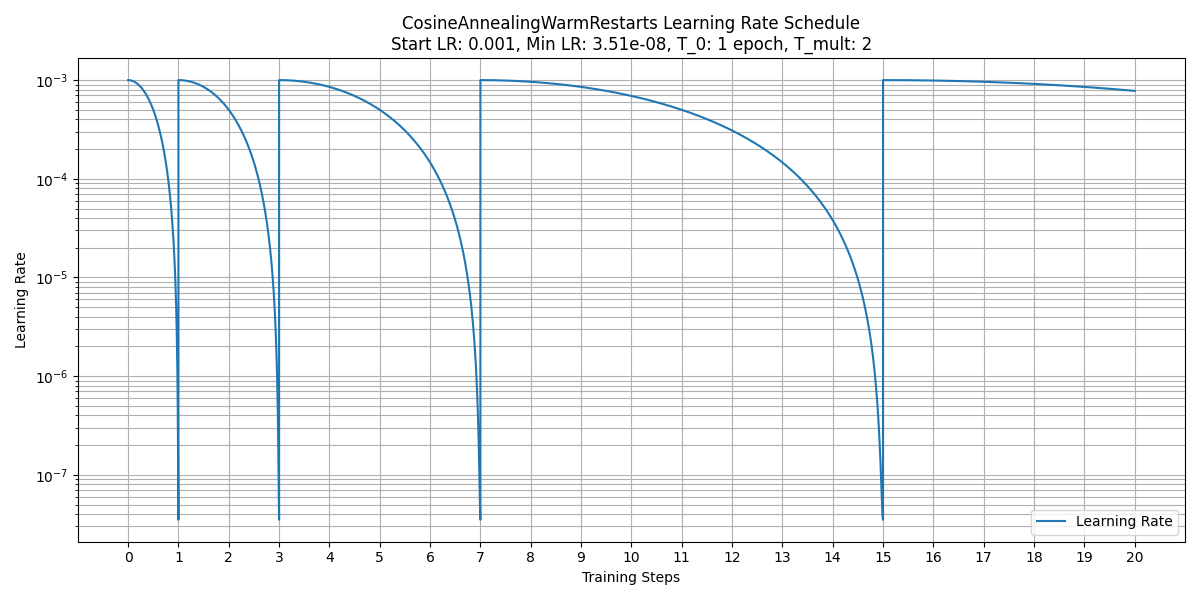
Cosine Annealing with Warm Restarts: t_0 and t_mult
Positive integers t_0 and t_mult enable cosine annealing with warm restarts for ADAM. Once enabled, optim.lr_scheduler.CosineAnnealingWarmRestarts controls the learning rate and the decay_step schedule is disabled.
-
t_0: length of the first cycle, in epochs. -
t_mult: factor by which the cycle length grows after each restart. -
The epoch at which cycle ends and the learning rate reaches its minimum is calculated as follows:
-
For
t_mult = 1, cycles have fixed lengtht_0. -
For
t_mult > 1, cycle lengths grow geometrically:
-
-
When cosine annealing is enabled, the model at each , immediately before restart, is saved under
model_record/saved_models.
In the figure below, learning_rate is 0.001, t_0=1, t_mult=2, and stop_lr is 3.51e-08. Restarts occur at epochs 1, 3, 7, 15, and so on.
Statistics of the first five restart epochs for each group
| Combination (T_0, T_mult) | 1st restart | 2nd restart | 3rd restart | 4th restart | 5th restart |
|---|---|---|---|---|---|
| (1, 2) | 1 | 3 | 7 | 15 | 31 |
| (1, 6) | 1 | 7 | 43 | 259 | 1555 |
| (2, 2) | 2 | 6 | 14 | 30 | 62 |
| (2, 4) | 2 | 10 | 42 | 170 | 682 |
| (2, 1) | 2 | 4 | 6 | 8 | 10 |
Detailed calculation process
-
(1, 2): The cycle lengths are
1, 2, 4, 8, 16...respectively
→ Restart points:1,1+2=3,3+4=7,7+8=15,15+16=31 -
(1, 6): The cycle lengths are
1, 6, 36, 216, 1296...respectively
→ Restart points:1,1+6=7,7+36=43,43+216=259,259+1296=1555 -
(2, 2): The cycle lengths are
2, 4, 8, 16, 32...respectively
→ Restart points:2,2+4=6,6+8=14,14+16=30,30+32=62 -
(2, 4): The cycle lengths are
2, 8, 32, 128, 512...respectively
→ Restart points:2,2+8=10,10+32=42,42+128=170,170+512=682 -
(2, 1): The cycle length is constant at
2, 2, 2, 2, 2...
→ Restart points:2, 4, 6, 8, 10(arithmetic progression)
Learning-Rate Scaling
scale_lr controls scaling by batch size and GPU count. The default is false, so the effective rate equals learning_rate.
When enabled, the default sqrt scaling is
"scale_lr": true,
"scaling_method": "sqrt"
This applies to ADAM, ADAMW, and SGD. Increasing batch size or GPU count increases the effective learning rate.
KF Optimizer Hyperparameters
The complete KF configuration is:
    "optimizer": {
        "optimizer": "LKF",
        "epochs": 30,
        "batch_size": 1,
        "print_freq": 10,
        "block_size": 5120,
        "p0_weight": 0.01,
        "kalman_lambda": 0.98,
        "kalman_nue": 0.9987,
        "train_energy": true,
        "train_force": true,
        "train_virial": false,
        "pre_fac_force": 2.0,
        "pre_fac_etot": 1.0,
        "pre_fac_virial": 1.0
    }
optimizer, epochs, batch_size, print_freq, train_energy, train_force, and train_virial have the same meanings as for ADAM.
block_size
Sets the block size of LKF covariance matrix P. Larger blocks consume more memory and train more slowly; smaller blocks may reduce convergence speed and accuracy. The default is 5120; 10240 is recommended for A100 or H100 GPUs.
p0_weight
LKF regularization parameter. The default 0.01 reduces overfitting and must be below 1; setting it to 1 disables regularization.
kalman_lambda
LKF memory factor controlling the weight of previous data. Larger values retain more history. The default is 0.98.
kalman_nue
LKF forgetting rate controlling how quickly kalman_lambda changes. The default is 0.9987.
pre_fac_etot
Weight of total energy in the loss. The default is 1.0.
pre_fac_force
Weight of force in the loss. The default is 2.0.
pre_fac_virial
Weight of virial in the loss. The default is 1.0.
-
Multi-GPU NEP training does not support LKF or GKF.
-
The size of covariance matrix
Pscales with the square ofN/block_size, whereNis the parameter count. Training many element types can therefore exhaust GPU memory and converge slowly.